







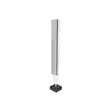


Bang & Olufsen Beolink 5000
Overview of Beolink 5000
To complement Beolink’s ability to distribute sound and picture seamlessly between products and rooms, Bang & Olufsen developed remote controls with two-way interactive and visual communication. The Beolink 5000, introduced in the early 1990s, was a milestone in this evolution. It featured a transparent display that provided live feedback on the system’s status, allowing users to operate their Bang & Olufsen setup—even from another room—with confidence and precision.
Design and Layout
Beolink 5000 was designed to balance advanced functionality with intuitive operation:
-
Front: Source selection buttons beneath the display, along with a circular arrangement of multifunction buttons for analogue and menu-driven controls.
-
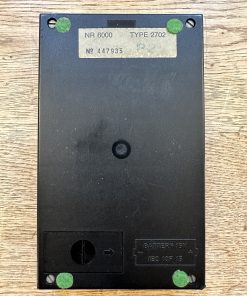
Back: Recessed secondary buttons for advanced functions such as programming and recording, placed here to avoid accidental use.
Despite its expanded capability, the unit remained slim and lightweight. The transparent LCD supertwist displayoffered excellent readability, even in bright light, and could be viewed from either side depending on the operation.
Key Features of Beolink 5000
-
Handheld terminal for audio, video, and AV systems in main and link rooms.
-
Two-way communication with status feedback on the display.
-
Logical grouping of controls for easy use.
-
Separation of main and advanced functions to prevent errors.
-
Support for timer programming, recording, and light control integration.
Compatibility
Beolink 5000 was especially suited to systems with advanced functions, such as:
-
Beosystem 4500 / 2300 / Beocenter 9500 – for timer recording, play-next functions, and full integration.
-
Beocord VX5000 – for advanced video programming.
-
Video Systems 5500 & 6000 – where recording and timer-programming features were maximized.
-
LC1 and LC2 light control units – programmable through Beocenter 9500.
Advanced Operation
The display acted as both a feedback panel and an interactive menu:
-
Primary functions: Immediate visual confirmation, e.g., when selecting sources or adjusting sound.
-
Secondary functions: Step-by-step prompts for complex operations such as programming, recording, or Teletext menus.
Notably, the remote allowed:
-
Safe recording operations via recessed rear buttons.
-
Control of up to two video recorders with direct start/stop access.
-
Timer programming even while the system was in standby.
Teletext Integration
Beolink 5000 simplified access to secondary Teletext functions (such as Large, Mix, Reveal, Update, Subcode) through its interactive display. Instead of hidden key combinations, users were guided by clear menu prompts, making complex functions straightforward.
Legacy
Beolink 5000 represented a leap forward in Bang & Olufsen’s remote control design. Its blend of two-way visual communication, advanced programming, and ergonomic layout made it a powerful companion for B&O’s sophisticated AV systems of the 1990s. It stood alongside Beolink 1000 and the later Beolink 7000, bridging the gap between simple control and intelligent system management.
PRODUCT SPECIFICATIONS
Beolink 5000 – Product Details
Type Numbers
-
1531 (1991 – May 1993)
-
1534 (USA) (1991 – May 1993)
-
1620 (MK II) (1992)
-
1623 (MK II, USA) (1992)
Designer
-
David Lewis
Manufactured
-
1991 – 1996
Colour Options
-
Grey
Technical Specifications
-
Power: 3 × AAA batteries
-
Weight: 240 g (including batteries)
-
Dimensions: 25.5 × 3.7 × 1.9 cm
PRODUCT CONDITION
Refurbished/Serviced – 1 year warranty
Be the first to review “Bang & Olufsen – B&O – Beolink 5000 Remote”
Related products




Reviews
There are no reviews yet.