









Bang & Olufsen Beolit 1000 (1967–1972)
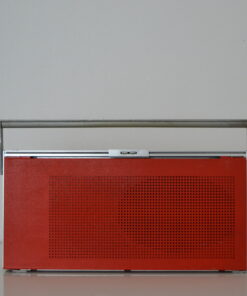
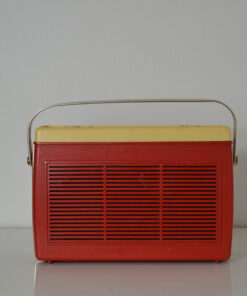
Designed by Jacob Jensen, the Beolit 1000 was the flagship of Bang & Olufsen’s portable radio range. It combined advanced engineering, versatile listening options and distinctive Danish design in a compact cabinet. Its design is represented in the permanent collection of the Museum of Modern Art in New York.
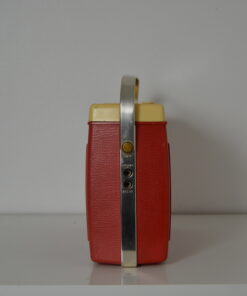
With reception across FM, medium wave, long wave and two shortwave bands, the Beolit 1000 offered extensive listening possibilities. Three adjustable FM presets provided convenient access to favourite stations, while switchable automatic frequency control helped maintain stable FM reception. Separate bass and treble controls allowed listeners to adjust the sound to their preferences.
The amplifier delivered 2.5 watts when operating on batteries through the built-in loudspeaker. With a suitable external power supply and loudspeaker connected, output increased to 7.5 watts, making the radio equally suited to portable listening or use as a compact mono home audio system. Connections for a record player or tape recorder added further flexibility.
The tuning system was particularly sophisticated for its time. A built-in DC-to-DC converter supplied the voltage required by the FM preset circuit, eliminating the separate tuning battery used in the earlier Beolit 500. Independent AM and FM tuning controls made operation straightforward, while the FM control also provided fine adjustment on the K2 shortwave band. A logging scale helped listeners record and return to station positions.
An optional lockable car-mounting bracket, known as the “autocassette,” extended the radio’s use to the road. Compatible with 6V and 12V systems using either positive or negative earth, it connected the Beolit 1000 to the vehicle’s battery, aerial and external speaker, providing up to 7.5 watts of output. Interference suppression and insulated external metal components reflected the attention given to its engineering.
Available in several finishes, the Beolit 1000 introduced styling details that would influence later Beolit models, bringing together practical controls, carefully considered proportions and impressive performance.
PRODUCT CONDITION
Used condition
PRODUCT SPECIFICATIONS
| Specification | Details |
|---|---|
| Brand | Bang & Olufsen |
| Model | Beolit 1000 |
| Type number | 1401 |
| Production period | 1967–1972 |
| Designer | Jacob Jensen |
| Radio bands | FM, MW, LW and 2 × SW |
| FM presets | 3 |
| Audio output | Mono |
| Power output | 2.5W on batteries; up to 7.5W with a suitable external power supply and loudspeaker |
| Tuning | Separate AM/FM tuning controls and shortwave fine tuning |
| Automatic frequency control | Switchable AFC for FM |
| Tone controls | Separate bass and treble |
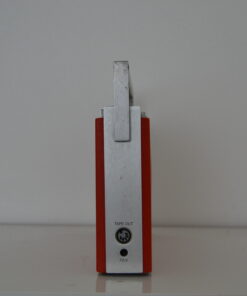
| Connections | Tape recorder/record player, external aerial, external loudspeaker and external power supply |
| Optional car mount | Supports 6V or 12V systems with positive or negative earth |
| Dimensions (W × H × D) | 359 × 201 × 70 mm |
| Finishes | Black goatskin |
Be the first to review “Bang & Olufsen – B&O – Beolit 1000 Black goatskin”
Related products




Reviews
There are no reviews yet.